


Good Things and Impatience
In a few weeks we’ll have our third quarter update (here are the Q1 and Q2 updates), but I’ll scoop my own story and share this: We’re already beyond our year-end targets on our taxable savings and 401(k)s. Even if our year-end bonuses aren’t huge, and even if the market takes a decent-sized dip before the end of the year, we’ll still beat our projections. Aiming higher this year has paid off big time.
We’ve always said we’d quit our jobs at the end of 2017, no matter what, though we had a number in mind that we wanted to hit to feel like we weren’t making a bonehead move. When we set that magic number as our goal, it seemed like a stretch, but it’s now looking like the much more likely scenario — barring a major financial crisis — is that we hit that magic number or come really close to it this year, a year early, and then pay off the mortgage and hit our super safe stretch number sometime in the spring or early summer of 2017.
If all that happens, it will be a major debate in the ONL house about whether to stay through the end of 2017 just to collect those bonuses. Mr. ONL thinks, quite reasonably, that we should stick it out through the end of the year, a sentiment that many of you share. Meanwhile I’m feeling extra impatient to leave work lately, and have a hard time fathoming continuing to work when 1.) we will have more than enough saved, and 2.) we can’t expect to spend more each year anyway without messing up our ACA subsidy calculations, especially given that we might try to work a little bit in retirement to hedge against sequence of returns risk.
We won’t know anything until this December, when we find out what our bonuses for the year will be, and then expect some hearty debate afterward on the topic. Until then, we’ll be over here pinching ourselves for having the best problem ever in the history of the world. #evenmoreawesomethanfirstworldproblems
But back to that impatience about leaving work. That’s what brings us to today’s topic: creating a flexible vision for your next life that’s based on presence, not absence.


When I’m feeling overwhelmed or frustrated at work, I quickly start daydreaming about the day when the work is gone. I’m positive we all do this, especially those of us working toward early retirement. Daydreaming is all in good fun for the most part, except when we’re actively working to put our daydreams into action, like with early retirement, and those daydreams will actually shape our thoughts about that thing we’re dreaming of.
In that moment, by focusing on a life with no work, I’m envisioning a future defined by absence, in this case the absence of work, instead of by the presence of some other, better whatever.
It’s not a big problem when it’s just those random passing thoughts. Clearly we still spend a lot of time defining an affirmative vision for our retirement, and the list of things we want to do is still longer than we’ll be able to get to.
But we’ve heard from a lot of folks that it’s much easier to focus on leaving work than it is to define a future-focused vision for early retirement. Do you find yourself falling into this trap? Do you focus more on what you can’t wait to leave behind instead of what you’re retiring to? Well you’re in luck, because today we’ve got graphics galore to make the case for why that vision is crucially important.
A Vision Based on Absence
Let’s do some simple math. Let’s say you have something, and you subtract a big piece of it. What do you have? Less.
Now let’s say that something is your life, and you subtract a big piece of it, which happens to be work.
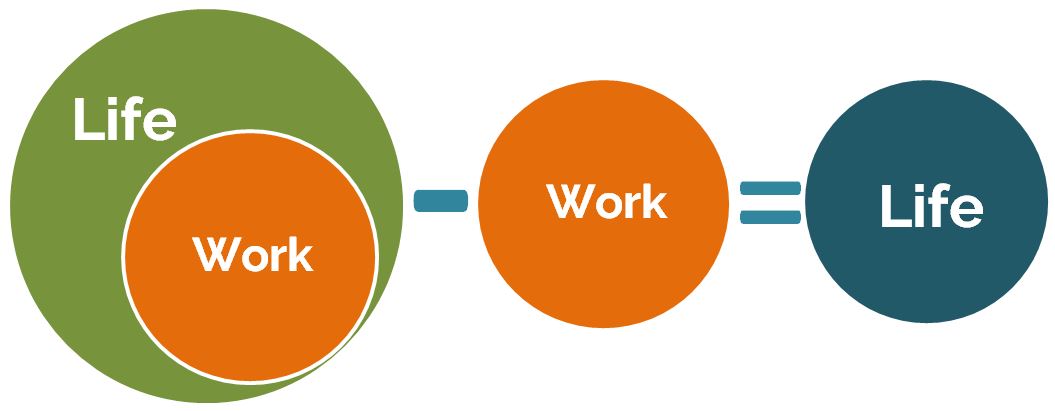

What do you have remaining? The answer is still less. All of a sudden, you have a smaller life.


A smaller life can mean a lot of things: A slower pace and shorter to do list (those might be very good things!), but also less social interaction, less to engage your mind, less to activate your passions. This is a recipe for a life with no purpose, where you find yourself asking, “How will I occupy my time?” And here’s a piece of advice if we ever gave one:
If you’re asking yourself how you’ll fill your time, you are not ready to retire early.
This is an early retirement vision based on absence, and that’s bound to lead to unhappiness, boredom and poor health. (More on that in a sec.) Early retirement is a beautiful gift, an incredible privilege, and it should never be about passing the time. It should be about living your very best life on your terms, as you define it.
So instead, let’s move away from absence and base that vision on presence.
A Vision Based on Presence
Back to that simple math problem. What if you take something, subtract something big, but then add in something else big? What do you have? More! 

If ever there was a time to live a bigger life, it’s in early retirement. A bigger life can mean anything, and its yours to define. It can be seeing more of the world, reading more of the books you’ve always wanted to devour, getting more involved in your community, scaling every peak on the continent and beyond — whatever fuels your stoke.
This is the time to dream in maximum bigness, to revive your childhood fantasies, to think about the things you see other people doing and think, “That’s so cool!” All of that can be in your new vision.
Keeping Your Vision Flexible
Of course, that vision doesn’t have to be one thing. You might have something big you want to incorporate into your life after retirement, but that doesn’t exclude learning, new hobbies, passion projects, random awesome things that come your way and maybe even a little work. 

The goal is to create a new vision and create space to go with the flow with new opportunities that come your way, things that may only be apparent as opportunities because you’re open and ready to jump at them.
You don’t have to have all the answers right at the outset, but having a vision for your new life from the beginning, to be supplemented by other things that come along, prevents you from falling into the retirement slump.
Getting It At Least Sort of Right At First
Many of us in the FIRE community like to talk about early retirement as though it is some fundamentally different thing from traditional retirement. But it’s not. You have a job or career that at least partially defines you for a long time, and definitely consumes a lot of your time, and suddenly that thing is gone. That is bound to be a tough transition for a lot of people, including those who think we’re nothing but excited to retire.
Rates of depression actually increase when people retire, rather than decrease, by a whopping 40 percent. Divorce increases. Health declines — dramatically. This is true across demographic groups, though men tend to have the hardest time transitioning to retired life. But if you’ve been thinking about your retirement in terms of leaving this one thing, and then suddenly it’s gone, you lose a big part of your identity and your world shrinks big time, it’s no wonder a high percent of people become depressed.
That’s why it’s so important not to go into retirement with the mindset of “I’ll figure out what I’ll do with my time once I get there.” The shock of the transition might make it hard to figure out what to do with your time, and that aimlessness is healthy for exactly no one. Figure out at least a starting vision, some things you want to do the first year, including how you’ll get social interaction, before you leap.
If you truly struggle to figure out what your vision for early retirement could look like, consider trying our purpose mapping exercise. Or keep working until you start to hear that voice telling you what you ought to be doing instead. There’s no shame in work, and no magical karma that you get for retiring early if you retire into a life of sitting on the couch and twiddling your thumbs. Or — worse — you end up going back to work because you were bored!
Chime In!
Do you struggle to envision what you’d like to do when you reach retirement? For those who’ve recently formed your vision, what helped you get over the hurdle? Or are you more like me where your problem is narrowing the list down to a vision that’s actually achievable? We’d love to hear from folks across the spectrum, especially those who’ve cracked the vision nut successfully!